
CPMI and IOSCO Release New Guidance on Managing Business Risks in Financial Market Infrastructures
Insight . Intelligence . Accountability
A new wave of professionals is transforming Governance, Risk, and Compliance from a rigid framework into a dynamic force for trust, innovation, and resilience. Governance, Risk, and Compliance (GRC) has long been associated with boardrooms and bureaucracy—a domain reserved for executives and auditors. But that image is changing fast.
Financial market infrastructures (FMIs) are being given further direction on how to manage business risks and maintain adequate financial resources following the release of new guidance by two major international financial standard-setting bodies.
The Committee on Payments and Market Infrastructures (CPMI) and the International Organization of Securities Commissions (IOSCO) have published their final guidance on the management of general business risks and the financial resources institutions should hold to absorb potential losses.
The publication follows an assessment that identified gaps in how some financial market infrastructures were applying existing international requirements, particularly those relating to the availability of liquid assets backed by equity.
The guidance is intended to help these institutions and their regulators better understand what is expected of them, particularly when financial difficulties could threaten an institution's ability to continue operating.
Understanding the requirements under Principle 15
The new guidance builds on the Principles for Financial Market Infrastructures (PFMI), the international standards that set out expectations for the safe and effective operation of critical financial market institutions.
These include payment systems, central securities depositories, securities settlement systems, central counterparties and trade repositories. Such institutions play an important role in ensuring that financial transactions are processed, cleared and settled reliably.
At the centre of the latest publication is Principle 15, which requires FMIs to identify, monitor and manage their general business risks. It also requires them to maintain sufficient liquid net assets funded by equity to cover potential business losses.
General business risks are different from losses arising from the default of a participant or other credit and liquidity exposures addressed by separate PFMI principles.
Instead, they relate to the financial risks an FMI faces through its ordinary business operations. These could arise from operational costs, changes in business conditions or other circumstances that affect its financial position.
Maintaining adequate financial resources is therefore important, particularly where an institution faces losses that could affect its ability to remain operational.
Financial resources, governance and risk oversight
The final guidance provides further direction on how FMIs should assess and manage general business risks, including how they determine the minimum amount of liquid net assets funded by equity needed to cover potential losses.
It also addresses the governance arrangements and transparency measures that should support these processes.
An important consideration is whether an institution has sufficient financial resources available when it needs them. These resources should not only support its ability to absorb losses but also help it manage financial difficulties and, where necessary, carry out an orderly wind-down of its operations.
The guidance also explains how general business risks should be considered alongside other risk categories covered by the PFMI framework.
This distinction matters because financial market infrastructures face different types of exposures, and each requires appropriate monitoring, controls and financial safeguards.
CPMI and IOSCO have made clear that the publication does not introduce new international standards or additional requirements. Rather, it provides further explanation of how existing PFMI expectations can be applied in practice, while recognizing that institutions may adopt different approaches that still meet the established principles.
Assessment identified weaknesses in implementation
The publication follows a consultation process launched in November 2025 and a Level 3 assessment examining how financial market infrastructures were implementing Principle 15.
The assessment identified shortcomings in the way some institutions managed general business risks and maintained the liquid net assets funded by equity required to absorb potential losses.
CPMI and IOSCO considered these findings alongside feedback received during the public consultation and earlier work examining how central counterparties manage losses that are unrelated to participant defaults.
The resulting guidance reflects the need for clearer direction on how institutions should interpret and apply the existing requirements.
It is also intended to provide supervisory authorities with a more consistent basis for assessing whether FMIs have appropriate financial resources and risk management arrangements in place.
What the guidance means for financial market institutions
The publication has practical implications for both FMI operators and the authorities responsible for their regulation and supervision.
Institutions will need to consider whether their existing risk management frameworks adequately identify and address general business risks. This includes reviewing how potential losses are assessed, whether available financial resources are sufficient and how governance arrangements support effective oversight.
Recovery and orderly wind-down planning also remain important considerations. Institutions should be able to demonstrate how they would respond if business losses placed their financial position or continued operations under pressure.
For regulators and supervisory authorities, the guidance provides additional direction when evaluating how institutions comply with Principle 15 and whether their arrangements are consistent with the broader PFMI framework.
CPMI and IOSCO have encouraged FMIs and their relevant authorities to consider the final guidance when assessing their implementation of the existing standards.
Strengthening resilience across financial markets
Financial market infrastructures support activities that are essential to the functioning of the global financial system. Weaknesses in their financial management can therefore have consequences beyond the institutions themselves.
The latest CPMI and IOSCO publication reinforces the importance of having adequate financial resources, clear governance arrangements and effective controls for managing business losses.
Although the guidance does not establish new international requirements, it gives institutions and supervisors a clearer reference for applying existing standards.
Its effectiveness will ultimately depend on how financial market infrastructures translate the guidance into their day-to-day risk management, financial planning and oversight practices.
As financial markets continue to evolve, maintaining the resilience of the institutions that support them remains an important part of safeguarding financial stability.
Source: Committee on Payments and Market Infrastructures (CPMI) and International Organization of Securities Commissions (IOSCO).
Your email address will not be published. Required fields are marked with *
CPMI and IOSCO Release New Guidance on Managing Business Risks in Financial Market Infrastructures
The Committee on Payments and Market Infrastructures (CPMI) and IOSCO have released final guidance to help financial market infrastructures strengthen their approach to managing business risks and preparing for potential financial losses. The guidance clarifies existing requirements under Principle 15 of the Principles for Financial Market Infrastructures, following an assessment that identified weaknesses in how some institutions were applying the standards.
# Telemedicine CEO Sentenced to 19 Years Over $1 Billion Medicare Fraud Scheme
A Kansas healthcare technology executive has been sentenced to 19 years in prison for his role in a fraud scheme that generated more than $1 billion in claims against Medicare and other federal healthcare programmes. The case exposed how fraudulent medical orders, illegal kickbacks and deceptive telemedicine practices were used to exploit public healthcare funds.
FATF Warns Gaming and Gambling Sectors Face Growing Financial Crime Risks
The Financial Action Task Force (FATF) has identified new ways criminals are exploiting gaming and gambling platforms to move money, evade controls and support wider criminal activity. With online and cross-border gambling expanding rapidly, the FATF has issued new risk indicators to help regulators, financial institutions and industry operators detect suspicious activity and respond to money laundering, terrorist financing and other financial crime risks.

Guns, Camouflage and Facebook: How Colombia’s ‘Narcoinfluencer’ Turned Crime Into Content
Nain Pérez, known online as Bendito Menor, built a huge following by mixing images of money, romance and armed life with a criminal persona. His rise shows how social media can turn organized crime into something dangerously close to celebrity culture.
ENISA Warns Digital Dependencies Are Expanding Europe’s Cyber Attack Surface
Europe’s growing reliance on interconnected digital technologies is creating new cybersecurity challenges, with ENISA warning that increasing digital dependencies could widen the region’s exposure to cyber threats, vulnerabilities and potential disruptions across critical sectors.
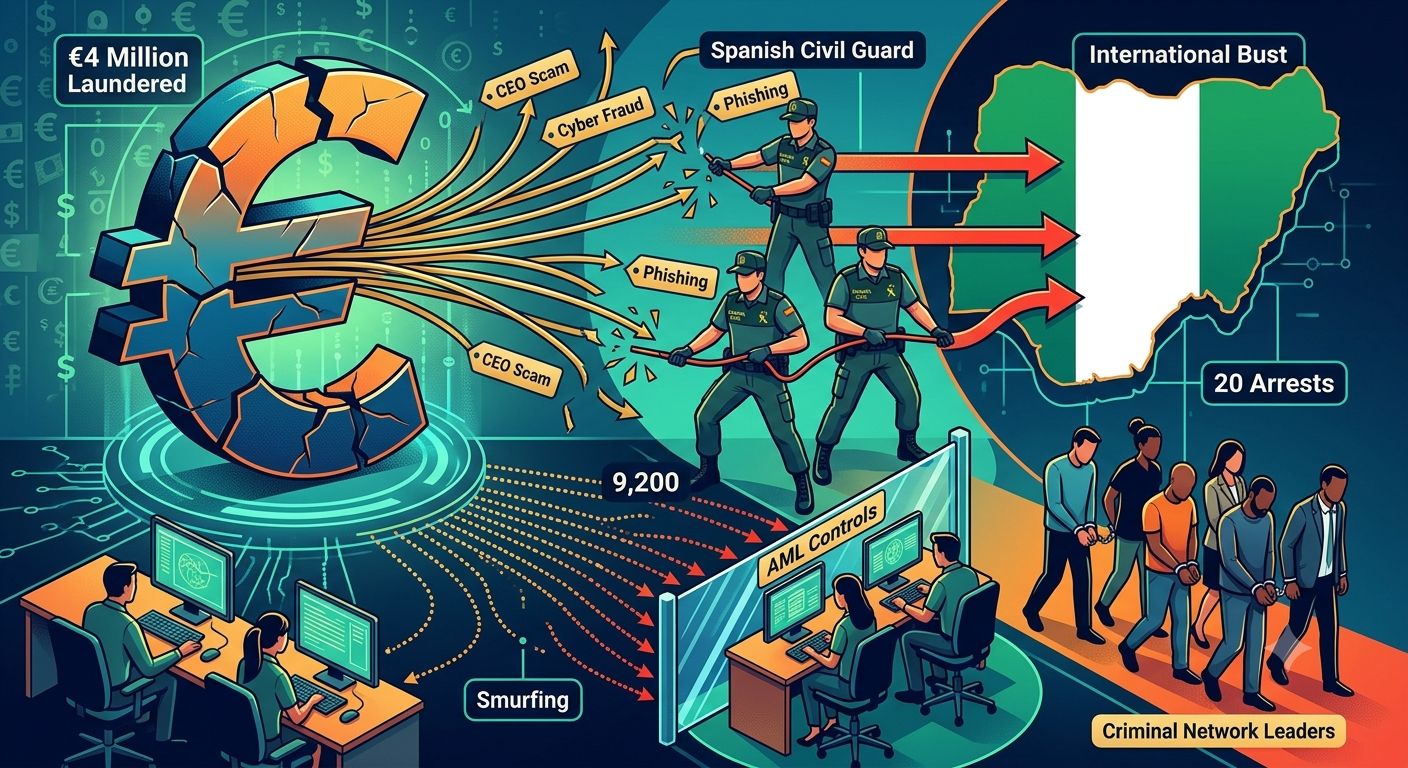
A network that laundered more than four million euros from scams by sending the money to Nigeria falls
Spanish Police Bust €4 Million International Money Laundering Ring Bound for Nigeria. The Spanish Civil Guard has dismantled a criminal network responsible for laundering over €4 million generated through cyber fraud, CEO scams, and identity theft across Europe. The organization utilized "smurfing"—splitting large illicit funds into more than 9,200 small-wire transfers using falsified passports and stolen identities—to bypass anti-money laundering controls and funnel cash into Nigeria. The two-phase operation led to 20 arrests, investigations into 11 others, and raids targeting key leaders in Bilbao as well as several complicit money transfer agencies.
No recommended articles found.