
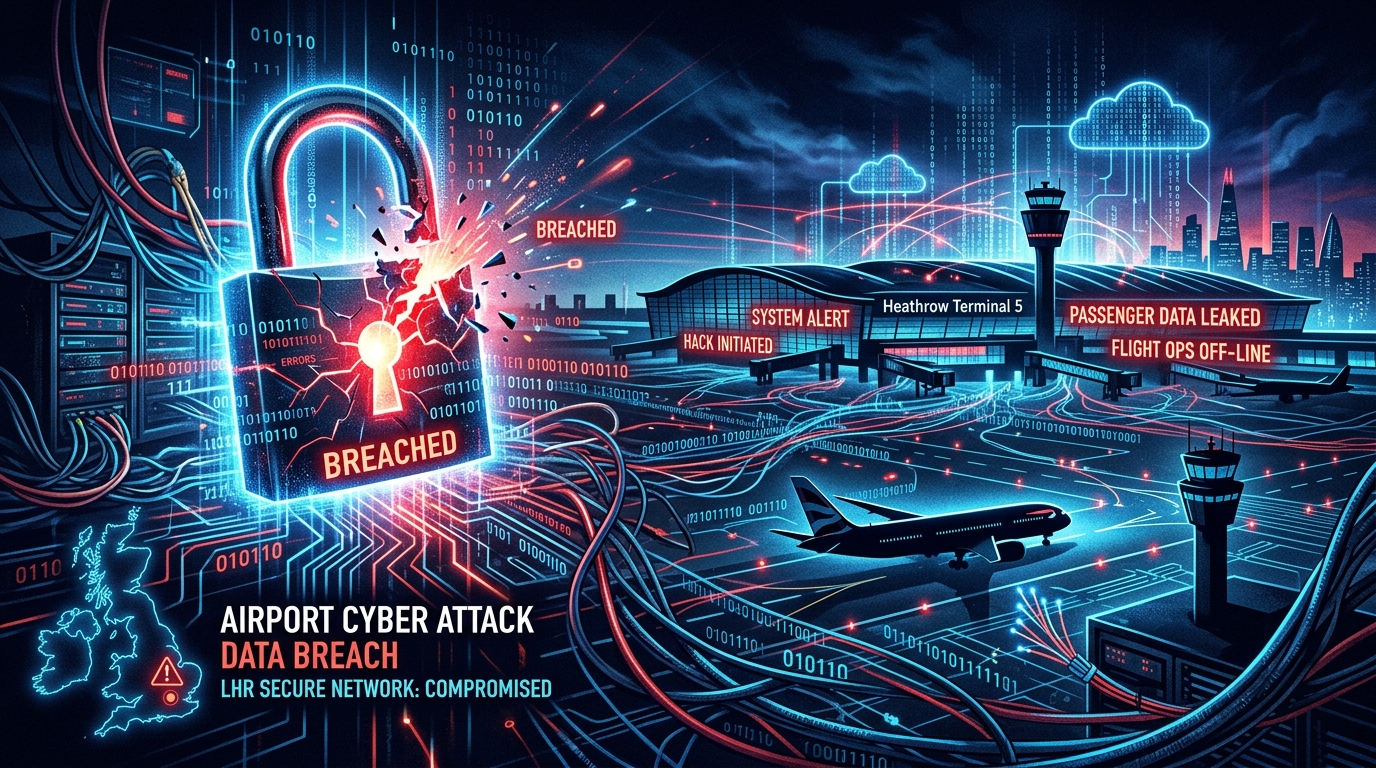
Cyberattack Exposes Data of 8.7 Million Customers at Three Major UK Airports
Insight . Intelligence . Accountability
A new wave of professionals is transforming Governance, Risk, and Compliance from a rigid framework into a dynamic force for trust, innovation, and resilience. Governance, Risk, and Compliance (GRC) has long been associated with boardrooms and bureaucracy—a domain reserved for executives and auditors. But that image is changing fast.
Deep Dive
Manchester Airports Group said criminal hackers accessed data belonging to about 8.7 million customers in a cyberattack affecting systems used across Manchester, London Stansted and East Midlands airports, one of the largest breaches of customer information disclosed by a UK airport operator.
The attackers gained access to the system over the weekend and demanded a ransom, according to reporting from The Guardian. Most of the compromised data consisted of email addresses collected when passengers signed up for airport WiFi, though some customers had additional information exposed, including vehicle registrations and postcodes.
The intrusion was large in the number of people it touched but, importantly, narrow in what it reached. MAG said the compromised system did not contain customers’ banking or payment information, and the attack did not penetrate the systems responsible for keeping aircraft and passengers safe.
“At no point has passenger safety or aviation security been compromised,” the company said.
There is no indication that flights, terminals or aviation security were endangered. What the attackers found instead was the less dramatic but enormous accumulation of personal information produced by the modern airport around the business of flying: the WiFi login, the parking reservation, the lounge booking, the fast-track purchase.
Most of the exposed data consisted only of email addresses associated with passengers who had registered for WiFi inside airport terminals, MAG said. More detailed information, including vehicle registrations and postcodes, was connected to customers who had used other airport services.
The company did not discover the intrusion until Tuesday. Once it became aware of the attack, MAG said it moved quickly to prevent the hackers from gaining further access, brought in specialist advisers and began notifying affected customers.
“We immediately contained the risk and have been working with specialist advisors and taking appropriate steps to protect our customers and systems,” MAG said. “We have informed and are working with the relevant authorities.”
MAG also apologized for the breach, saying it takes the security of customer information “extremely seriously.”
The absence of payment information limits one obvious avenue for fraud, but it does not make the stolen data harmless. An email address is modest information until it arrives in the hands of someone who knows where it came from. Details connecting a person to an airport, a parking reservation or another travel service can give a fraudulent message the small measure of credibility it needs to survive the first few seconds of suspicion.
MAG has consequently urged customers to pay particular attention to unexpected emails, text messages and phone calls, and to avoid opening attachments they do not recognize.
For the airport group, the breach also exposes a problem that extends well beyond the systems most obviously associated with aviation. An airport does not merely move people through terminals and onto aircraft. It runs an expanding collection of digital services around them, gathering pieces of information at each point where convenience asks for an email address, a postcode or a vehicle registration.
None of those details looks especially consequential on its own. Across 8.7 million customers, they become something else.
That is the scale MAG is now confronting. The systems responsible for aviation safety remained secure, according to the company, and there is no indication that the attackers disrupted the airports themselves. The damage lies instead in information accumulated quietly through millions of routine transactions, much of it surrendered by travelers for something as forgettable as getting online before a flight.
Comments (2)
Your email address will not be published. Required fields are marked with *
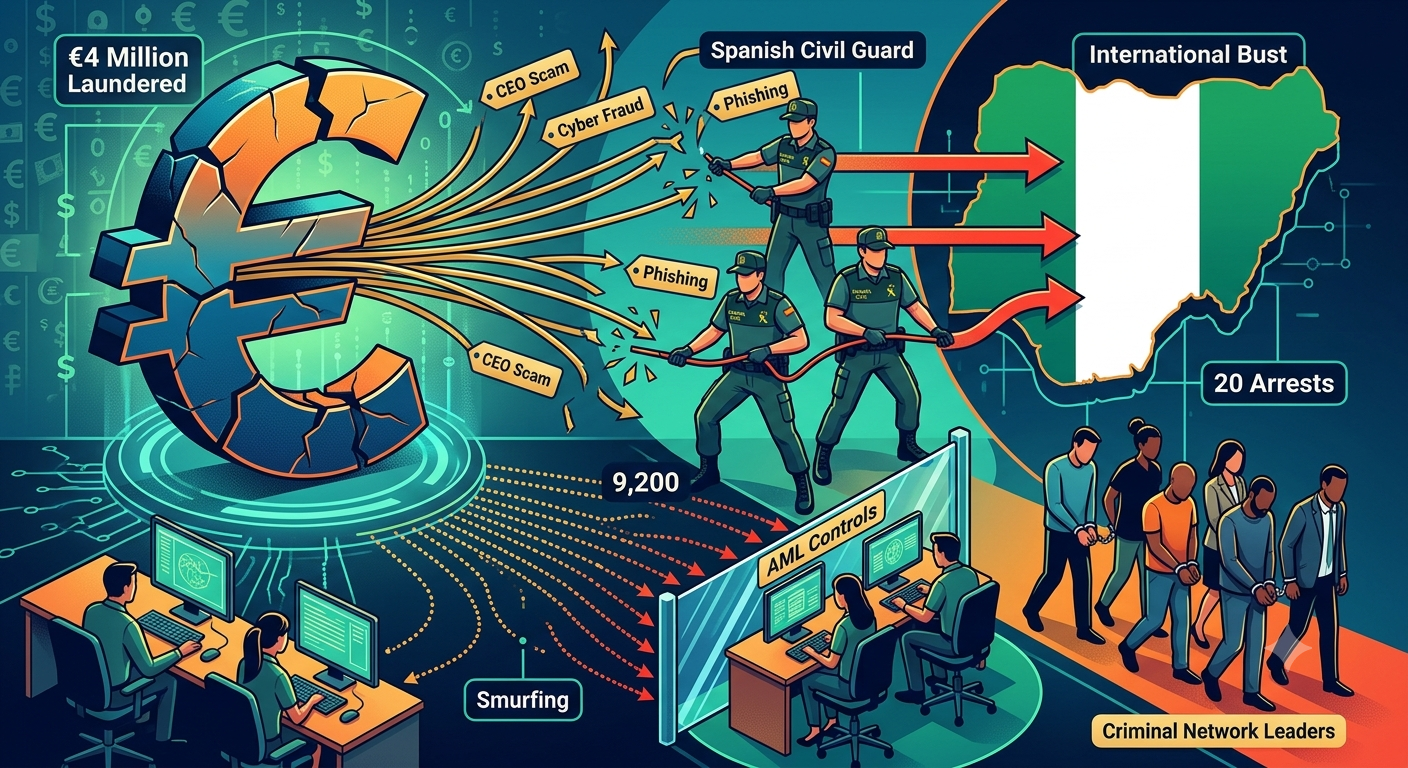
A network that laundered more than four million euros from scams by sending the money to Nigeria falls
Spanish Police Bust €4 Million International Money Laundering Ring Bound for Nigeria. The Spanish Civil Guard has dismantled a criminal network responsible for laundering over €4 million generated through cyber fraud, CEO scams, and identity theft across Europe. The organization utilized "smurfing"—splitting large illicit funds into more than 9,200 small-wire transfers using falsified passports and stolen identities—to bypass anti-money laundering controls and funnel cash into Nigeria. The two-phase operation led to 20 arrests, investigations into 11 others, and raids targeting key leaders in Bilbao as well as several complicit money transfer agencies.
U.S. Regulators Hit UBS With $173 Million in Coordinated AML Enforcement Action
Eight years after promising regulators it would fix persistent weaknesses in its anti-money laundering controls, UBS is paying for what those regulators say it failed to finish.
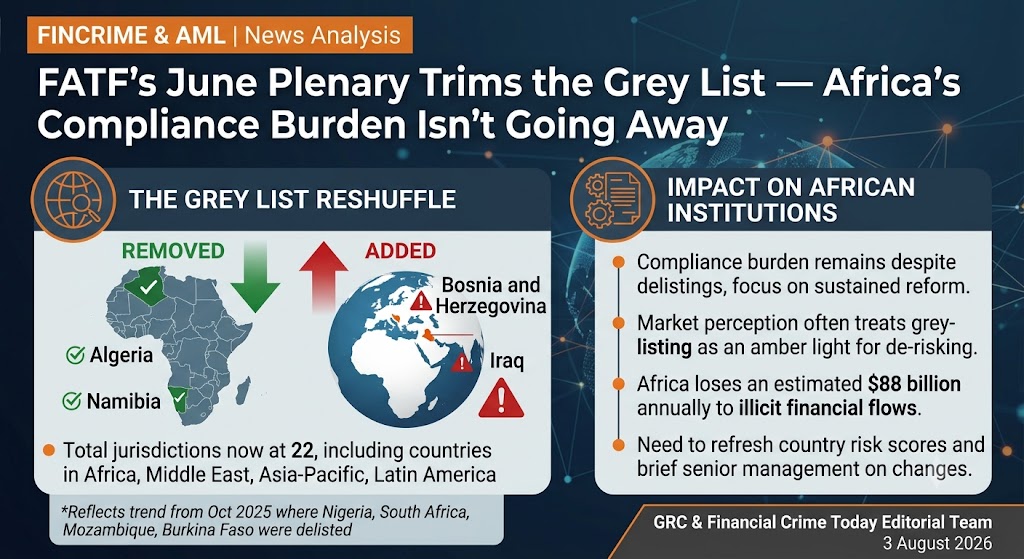
FATF's June Plenary Trims the Grey List — Africa's Compliance Burden Isn't Going Away
The Financial Action Task Force closed its June 2026 plenary by removing Algeria and Namibia from its list of jurisdictions under increased monitoring, while adding Bosnia and Herzegovina and Iraq. For African compliance functions, the headline delisting matters less than what it confirms about the direction of travel.

RegTech Won't Save You From a Bad Governance Model. It Will Just Automate It Faster.
Every compliance leader I meet is being asked, in some form, what their AI strategy is. Almost none of them are being asked the more important question first: what is your governance model for the AI you already have?
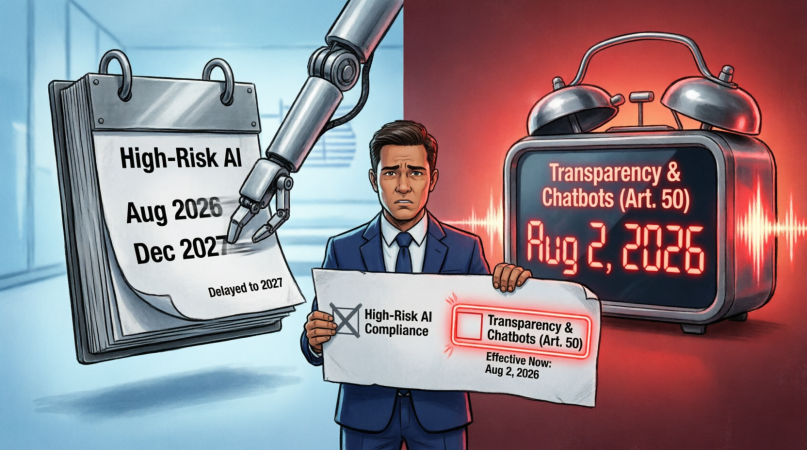
The EU AI Act's August Deadline Arrives — Just Not the One Everyone Expected
High-risk AI obligations for financial services have been pushed back sixteen months. Transparency rules for chatbots and synthetic media have not moved at all — and enforcement power against general-purpose AI providers switches on this week.

Third-Party Risk Is a Board Issue Now, Not a Procurement Checklist
Outsourcing does not outsource accountability. Regulators have said this for years. Boards are only now starting to act as though they believe it.
No recommended articles found.