
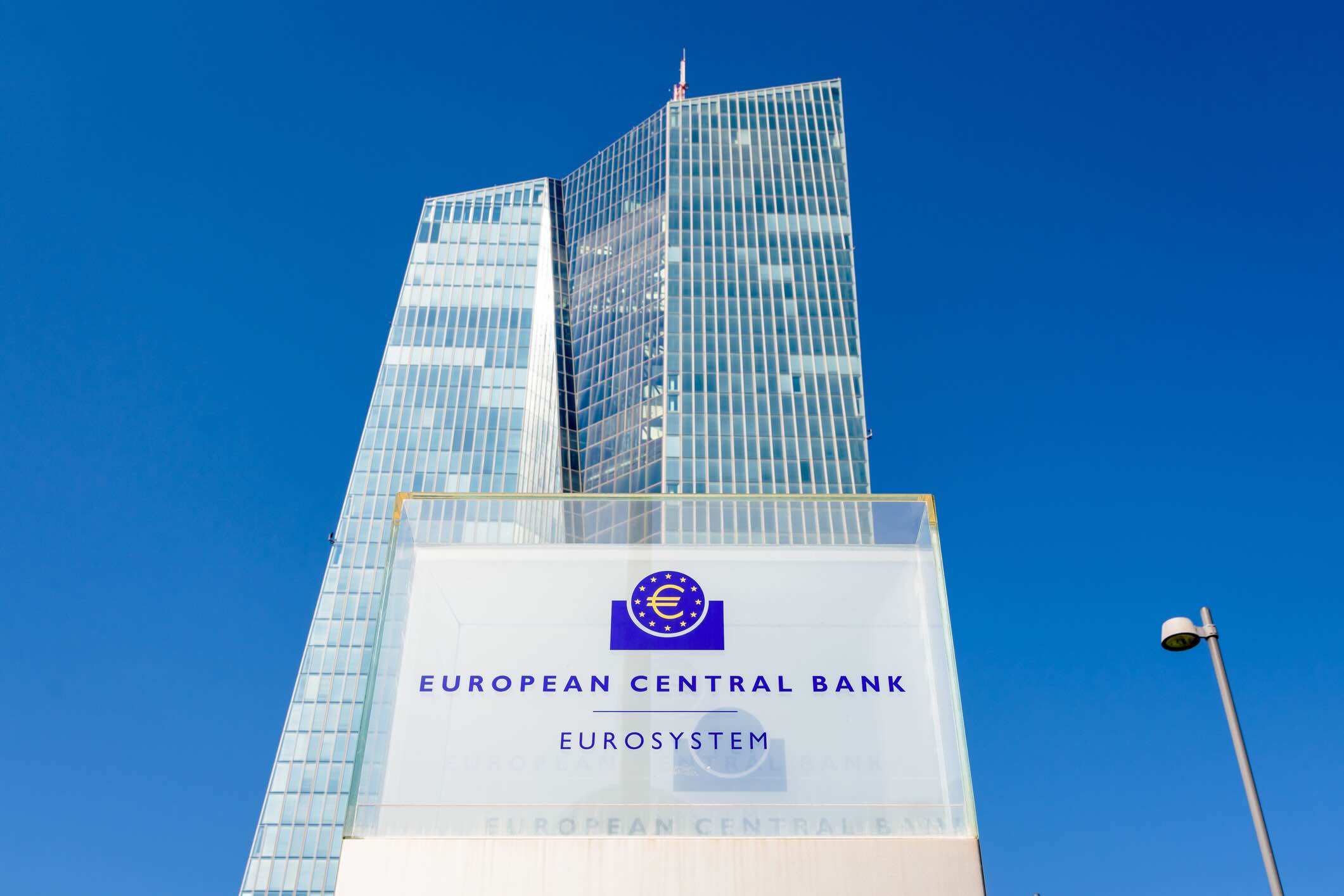
ECB Expands Climate Risk Framework to Corporate Credit Claims
Insight . Intelligence . Accountability
A new wave of professionals is transforming Governance, Risk, and Compliance from a rigid framework into a dynamic force for trust, innovation, and resilience. Governance, Risk, and Compliance (GRC) has long been associated with boardrooms and bureaucracy—a domain reserved for executives and auditors. But that image is changing fast.
Key Takeaways
Collateral Framework Expanded: The European Central Bank will extend climate-related valuation adjustments to certain eligible credit claims owed by non-financial corporations.
Transition Risk Assessment: Climate factors will reflect exposure to transition-related uncertainties, including policy changes, technological developments, litigation, consumer behavior and broader macroeconomic shifts.
Risk-Based Valuation: The size of the adjustment will be determined using an asset-level uncertainty score based on sector stress, debtor exposure and the remaining maturity of each credit claim.
5% Maximum Reduction: The additional climate-related reduction applied to collateral value will remain capped at 5% across eligible corporate bonds and credit claims.
Rollout Planned for 2027: The ECB expects to implement the expanded framework no earlier than the end of 2027, with climate factor values updated annually.
Deep Dive
The European Central Bank has spent the past year teaching its collateral framework a new habit. First it learned to look at corporate bonds through the lens of climate-related transition risk. Now it will do the same for a broader class of assets that sit behind the Eurosystem's lending operations.
The ECB's Governing Council has approved an extension of climate factors to certain eligible credit claims whose debtor is a non-financial corporation. The decision widens a framework introduced for marketable corporate assets in July 2025 and brought into force on June 15, 2026. This time the focus is on loans and other eligible credit claims that counterparties pledge as collateral when borrowing from the Eurosystem.
The mechanics are straightforward, even if the risks are not. When banks obtain liquidity through Eurosystem refinancing operations, they pledge eligible assets as collateral. Those assets are assigned a value, and that value already reflects a range of financial risks. The ECB has concluded that climate-related transition shocks belong in that calculation as well.
Its concern is not physical climate damage but the financial consequences of the transition itself. A shift in climate policy, a technological breakthrough, changing consumer preferences, litigation or wider economic adjustments can alter the value of corporate assets with surprising speed. If the Eurosystem ever has to liquidate collateral following such a shock, those changes matter.
The more exposed an eligible credit claim is to those uncertainties, the larger the reduction applied to its collateral value. That adjustment will be based on an asset-level uncertainty score combining three elements, including a sector-level stress indicator drawn from the Eurosystem's latest climate stress test, the debtor's exposure to transition-related uncertainty and the residual maturity of the credit claim. Where detailed industry or debtor information is unavailable, the ECB said the Eurosystem may rely on sector-level data or other alternative datasets suitable for assessing the relevant risks.
A Measured Expansion
The new measure does not fundamentally alter the ECB's collateral framework so much as extend a principle it has already adopted. The maximum additional reduction in collateral value attributable to climate factors will remain 5%, whether the asset is an eligible corporate bond or an eligible credit claim. The ECB also said it will not publish climate factor values for individual credit claims, avoiding public rankings of specific assets or borrowers.
Implementation is not imminent. The central bank expects the expanded framework to take effect no earlier than the end of 2027. Once introduced, climate factor values will be refreshed each year using the same process already applied to non-financial corporate bonds, allowing the framework to incorporate the latest available climate-related data.
The decision reflects a steady evolution rather than a sudden shift. Climate considerations are becoming another variable inside the Eurosystem's risk management toolkit, not because the ECB is redefining monetary policy, but because it increasingly views the financial consequences of the green transition as risks that belong inside the same framework used to value every other form of collateral.
The GRC Report is your premier destination for the latest in governance, risk, and compliance news. As your reliable source for comprehensive coverage, we ensure you stay informed and ready to navigate the dynamic landscape of GRC. Beyond being a news source, the GRC Report represents a thriving community of professionals who, like you, are dedicated to GRC excellence. Explore our insightful articles and breaking news, and actively participate in the conversation to enhance your GRC journey.
Your email address will not be published. Required fields are marked with *
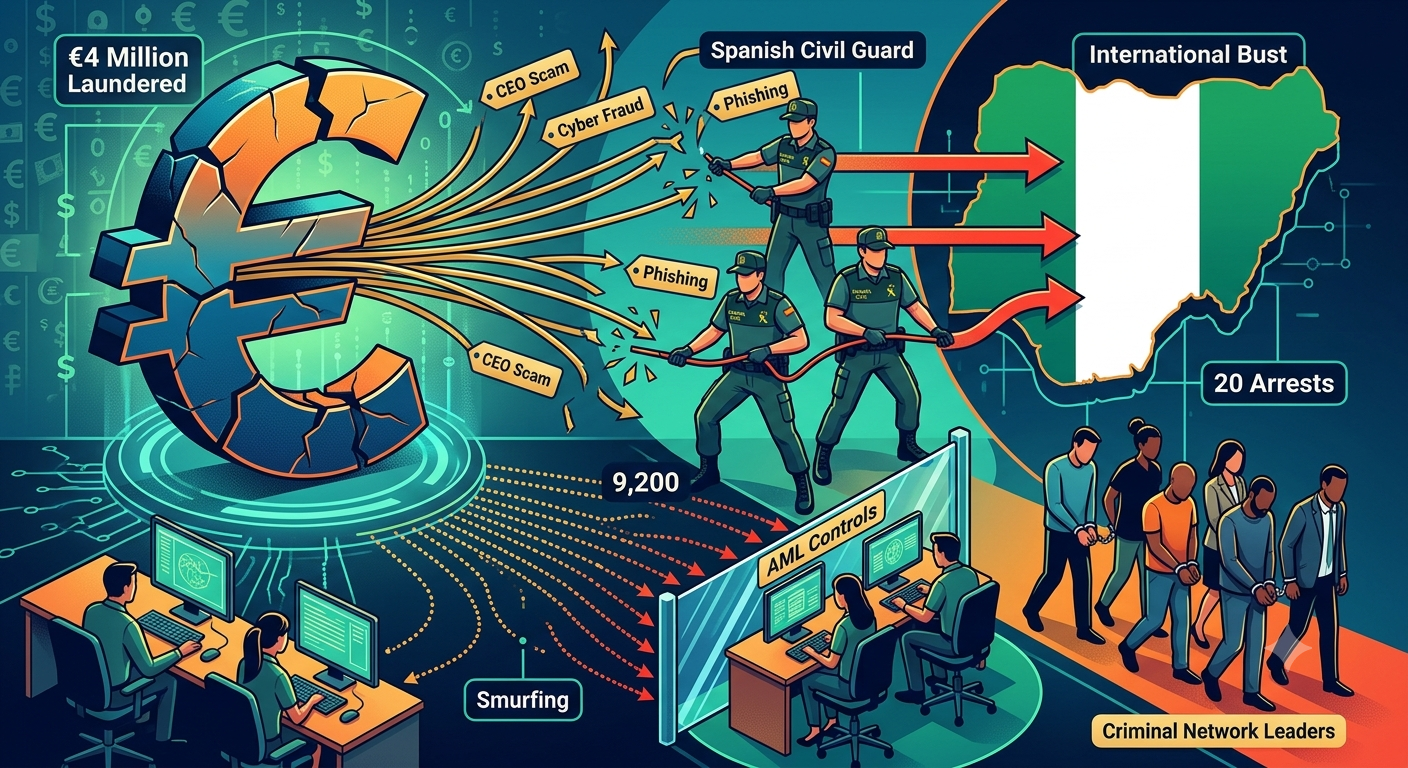
A network that laundered more than four million euros from scams by sending the money to Nigeria falls
Spanish Police Bust €4 Million International Money Laundering Ring Bound for Nigeria. The Spanish Civil Guard has dismantled a criminal network responsible for laundering over €4 million generated through cyber fraud, CEO scams, and identity theft across Europe. The organization utilized "smurfing"—splitting large illicit funds into more than 9,200 small-wire transfers using falsified passports and stolen identities—to bypass anti-money laundering controls and funnel cash into Nigeria. The two-phase operation led to 20 arrests, investigations into 11 others, and raids targeting key leaders in Bilbao as well as several complicit money transfer agencies.

U.S. Regulators Hit UBS With $173 Million in Coordinated AML Enforcement Action
Eight years after promising regulators it would fix persistent weaknesses in its anti-money laundering controls, UBS is paying for what those regulators say it failed to finish.
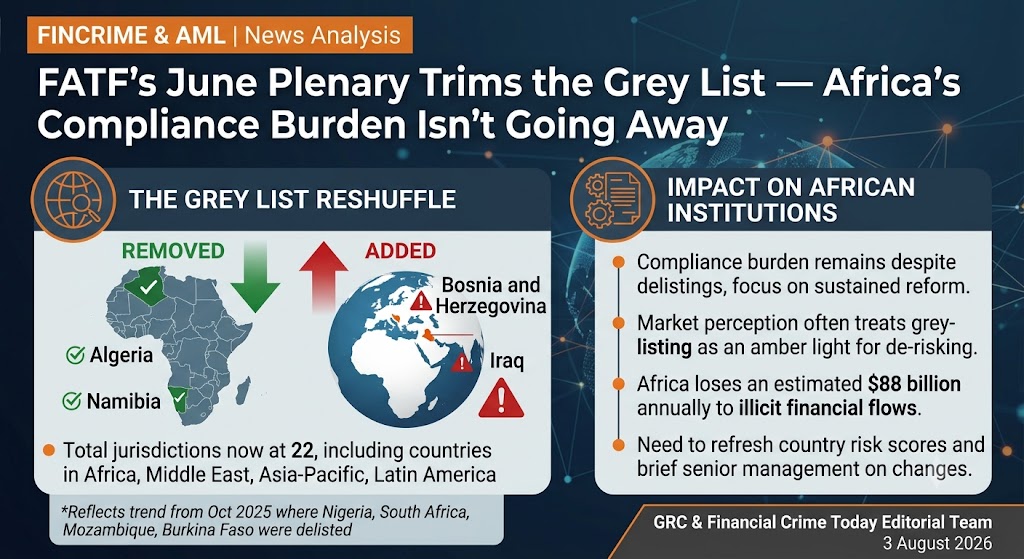
FATF's June Plenary Trims the Grey List — Africa's Compliance Burden Isn't Going Away
The Financial Action Task Force closed its June 2026 plenary by removing Algeria and Namibia from its list of jurisdictions under increased monitoring, while adding Bosnia and Herzegovina and Iraq. For African compliance functions, the headline delisting matters less than what it confirms about the direction of travel.

RegTech Won't Save You From a Bad Governance Model. It Will Just Automate It Faster.
Every compliance leader I meet is being asked, in some form, what their AI strategy is. Almost none of them are being asked the more important question first: what is your governance model for the AI you already have?

The EU AI Act's August Deadline Arrives — Just Not the One Everyone Expected
High-risk AI obligations for financial services have been pushed back sixteen months. Transparency rules for chatbots and synthetic media have not moved at all — and enforcement power against general-purpose AI providers switches on this week.

Third-Party Risk Is a Board Issue Now, Not a Procurement Checklist
Outsourcing does not outsource accountability. Regulators have said this for years. Boards are only now starting to act as though they believe it.
No recommended articles found.