FATF's June Plenary Trims the Grey List — Africa's Compliance Burden Isn't Going Away
Insight . Intelligence . Accountability
A new wave of professionals is transforming Governance, Risk, and Compliance from a rigid framework into a dynamic force for trust, innovation, and resilience. Governance, Risk, and Compliance (GRC) has long been associated with boardrooms and bureaucracy—a domain reserved for executives and auditors. But that image is changing fast.
FATF's June Plenary Trims the Grey List — Africa's Compliance Burden Isn't Going Away
GRC & Financial Crime Today Editorial Team
3 August 2026
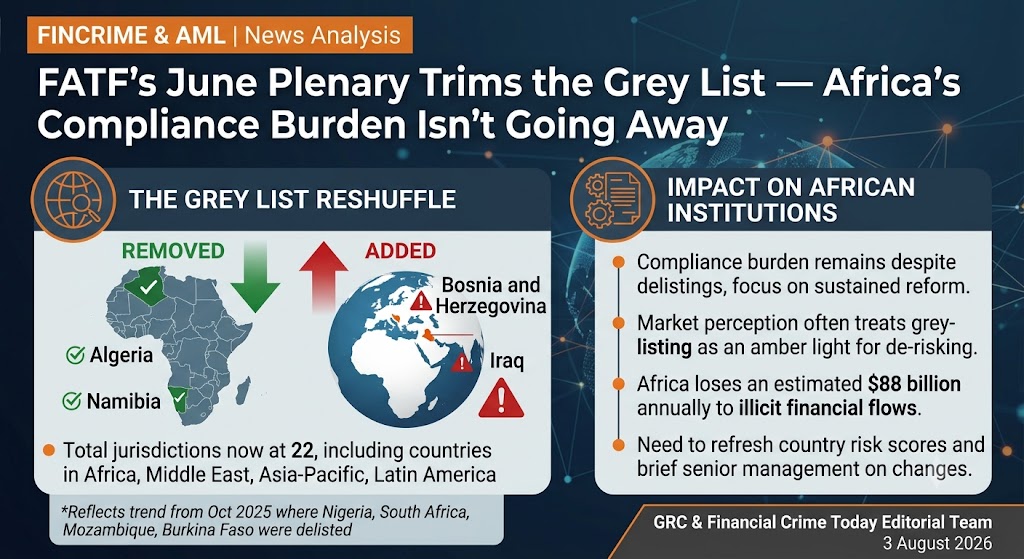
The Financial Action Task Force closed its June 2026 plenary by removing Algeria and Namibia from its list of jurisdictions under increased monitoring, while adding Bosnia and Herzegovina and Iraq. For African compliance functions, the headline delisting matters less than what it confirms about the direction of travel.
The Financial Action Task Force's June 2026 plenary produced the kind of update that compliance teams have come to expect twice a year: a reshuffle of the grey list, a handful of jurisdictions rewarded for completed reform programmes, and a reminder that the list itself is never static. Algeria and Namibia both exited the list of jurisdictions under increased monitoring after on-site verification confirmed they had closed out their agreed action plans, working respectively through MENAFATF and ESAAMLG, the regional bodies that shepherd countries through the FATF process. Bosnia and Herzegovina and Iraq took their place, each now working to time-bound plans covering deficiencies in money laundering, terrorist financing and proliferation financing controls.
The total number of jurisdictions under increased monitoring now stands at 22, spanning Africa, the Middle East, Asia-Pacific, Latin America and a scattering of smaller territories. For African markets specifically, the June outcome continues a pattern set in October 2025, when Nigeria, South Africa, Mozambique and Burkina Faso were removed from the list after multi-year reform programmes — evidence that sustained political commitment and technical assistance can shift a country's risk classification within a reasonable timeframe, even if the process rarely feels fast to the institutions living through it.
Grey-listing does not automatically trigger enhanced due diligence in most regulatory regimes — but in practice, correspondent banks and institutional counterparties often act as though it does.
That gap between the formal rule and the market's actual behaviour is where the real cost of grey-listing sits. FATF is explicit that inclusion on the list is meant to inform risk-based assessment, not to trigger automatic sanctions or blanket enhanced due diligence. In practice, correspondent banks, reinsurers and institutional counterparties frequently treat a grey-listing as a de facto amber light, tightening account relationships, adding friction to trade finance, or de-risking entirely rather than absorbing the compliance cost of a more nuanced assessment. The United Nations has previously estimated that Africa loses in the order of $88 billion annually to illicit financial flows — money laundering, tax evasion and corruption combined — a figure that gives some sense of the scale regulators across the continent are working against, and why delisting, however welcome, is a waypoint rather than a destination.
What This Means for Compliance Functions
For institutions with exposure to the affected jurisdictions, the practical task list is straightforward, even if the underlying data work rarely is. Country risk scores need to move — down for Algeria and Namibia, up for Bosnia and Herzegovina and Iraq — and that repricing needs to flow through onboarding decisions, not just sit in a static risk register. Customer, beneficial ownership and payment-corridor mapping should be refreshed against the new list, ideally through centralised KYC and transaction-monitoring data rather than manual lookups. And senior management should be briefed on the change, not because the plenary outcome is dramatic, but because grey-list movement is one of the few compliance signals that boards can be reasonably expected to track in real time.
The broader lesson for African financial institutions and their advisers is one of patience allied to rigour. Delisting is achievable, as Nigeria, South Africa, Algeria and Namibia have each now demonstrated, but it is earned through multi-year, evidenced reform rather than a single legislative gesture. Institutions operating in jurisdictions still on the list, or newly added to it, should treat the FATF calendar as a fixed feature of their risk-assessment cycle — not an occasional news story to react to, but a structural input to plan around.
Sources: FATF plenary outcomes, June 2026; UN estimates on illicit financial flows in Africa. This article is intended as general commercial awareness and does not constitute regulatory or legal advice.
Your email address will not be published. Required fields are marked with *
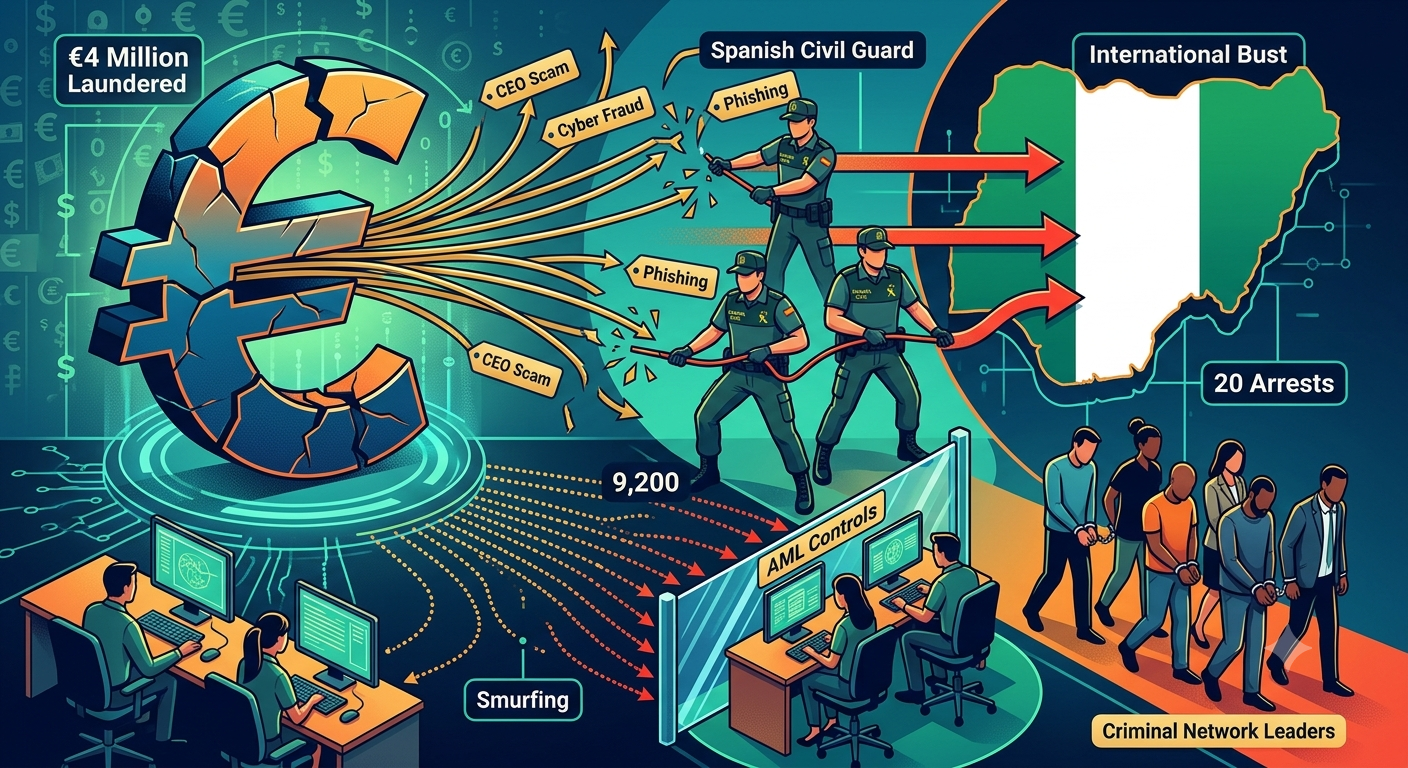
A network that laundered more than four million euros from scams by sending the money to Nigeria falls
Spanish Police Bust €4 Million International Money Laundering Ring Bound for Nigeria. The Spanish Civil Guard has dismantled a criminal network responsible for laundering over €4 million generated through cyber fraud, CEO scams, and identity theft across Europe. The organization utilized "smurfing"—splitting large illicit funds into more than 9,200 small-wire transfers using falsified passports and stolen identities—to bypass anti-money laundering controls and funnel cash into Nigeria. The two-phase operation led to 20 arrests, investigations into 11 others, and raids targeting key leaders in Bilbao as well as several complicit money transfer agencies.

U.S. Regulators Hit UBS With $173 Million in Coordinated AML Enforcement Action
Eight years after promising regulators it would fix persistent weaknesses in its anti-money laundering controls, UBS is paying for what those regulators say it failed to finish.
FATF's June Plenary Trims the Grey List — Africa's Compliance Burden Isn't Going Away
The Financial Action Task Force closed its June 2026 plenary by removing Algeria and Namibia from its list of jurisdictions under increased monitoring, while adding Bosnia and Herzegovina and Iraq. For African compliance functions, the headline delisting matters less than what it confirms about the direction of travel.

RegTech Won't Save You From a Bad Governance Model. It Will Just Automate It Faster.
Every compliance leader I meet is being asked, in some form, what their AI strategy is. Almost none of them are being asked the more important question first: what is your governance model for the AI you already have?

The EU AI Act's August Deadline Arrives — Just Not the One Everyone Expected
High-risk AI obligations for financial services have been pushed back sixteen months. Transparency rules for chatbots and synthetic media have not moved at all — and enforcement power against general-purpose AI providers switches on this week.

Third-Party Risk Is a Board Issue Now, Not a Procurement Checklist
Outsourcing does not outsource accountability. Regulators have said this for years. Boards are only now starting to act as though they believe it.
No recommended articles found.