
FATF's New Fraud Agenda, a Record INTERPOL Sweep, and a Wave of Regulatory Reform
Insight . Intelligence . Accountability
A new wave of professionals is transforming Governance, Risk, and Compliance from a rigid framework into a dynamic force for trust, innovation, and resilience. Governance, Risk, and Compliance (GRC) has long been associated with boardrooms and bureaucracy—a domain reserved for executives and auditors. But that image is changing fast.
Global Financial Crime Watch: FATF's New Fraud Agenda, a Record INTERPOL Sweep, and a Wave of Regulatory Reform
GRC FinCrime Today — Global Roundup | July 2026
The middle of 2026 has delivered one of the busiest stretches for financial crime prevention professionals in recent memory. The Financial Action Task Force has handed its presidency to the United Kingdom with fraud at the top of the agenda, INTERPOL has concluded its largest-ever anti-fraud operation, and regulators from Washington to London, Brussels, Stockholm and Abuja have signalled that supervisory expectations are tightening across every sector. Here is what compliance leaders need to know.
FATF: Grey List Reshuffled as the UK Presidency Puts Fraud Centre Stage
The FATF concluded its June 2026 Plenary in Paris (17–19 June) with significant changes to its list of jurisdictions under increased monitoring. Iraq and Bosnia and Herzegovina were added to the grey list, while Algeria and Namibia were removed following successful on-site visits confirming completion of their action plans. The grey list now stands at 22 jurisdictions. The black list — Iran, North Korea and Myanmar — remains unchanged, and the FATF's suspension of the Russian Federation continues.
For financial institutions, the practical implications are immediate. Firms with exposure to Iraq or Bosnia and Herzegovina should update their enterprise-wide risk assessments, revisit country risk ratings, and apply enhanced due diligence proportionate to the elevated risk, while avoiding indiscriminate de-risking of legitimate customers connected to those markets.
The Plenary also marked a leadership transition. Elisa de Anda Madrazo of Mexico concluded her term, and Giles Thomson of the United Kingdom assumed the presidency from 1 July 2026 for a two-year term. The UK Presidency has confirmed three priorities: stepping up the international response to the global fraud epidemic — including the money laundering and terrorist financing risks flowing from scam compounds — strengthening implementation of the risk-based approach and risk-based supervision, and enhancing information sharing through public-private partnerships. Vivek Aggarwal of India was appointed Vice-President for 2026–27.
Other Plenary outcomes deserving attention include the adoption of mutual evaluation reports for Canada and Türkiye under the new assessment round, an update to Recommendation 6 incorporating humanitarian exemptions to targeted financial sanctions, and a commitment to publish new typology reports on emerging risks such as the abuse of online gaming platforms and underground banking channels.
The direction of travel is unmistakable: fraud, long treated as a predicate offence sitting adjacent to the AML/CFT framework, is now being pulled into the centre of the global standard-setter's agenda.
INTERPOL's Operation First Light 2026: Nearly 6,000 Arrests Across 97 Countries
INTERPOL announced in July the results of Operation First Light 2026, a coordinated global anti-fraud operation that ran from 15 January to 30 April 2026 across 97 countries and territories. According to INTERPOL, the operation led to the arrest of 5,811 individuals and the interception of approximately USD 293 million in illicit assets, spanning both fiat currency and virtual assets.
The operation targeted social engineering fraud, business email compromise, romance scams, investment fraud, impersonation schemes, and sextortion together with the money laundering networks that move the proceeds. INTERPOL reported that more than 142,000 victims were identified worldwide, over 31,000 bank accounts were blocked, and 99 INTERPOL Notices and Diffusions were issued. Authorities made proactive use of the organization's Global Rapid Intervention of Payments (I-GRIP) stop-payment mechanism; in one case highlighted by INTERPOL, authorities in Singapore and Oman used I-GRIP to block a USD 6.6 million transfer linked to a business email compromise scheme targeting a commodity trading firm.
The operation also exposed the growing sophistication of crypto-enabled laundering. Thai police reported uncovering a scheme in which romance scam proceeds were moved through cross-chain token swaps to obscure the trail, with a single wallet said to have processed more than USD 122 million in ten months.
The findings sit alongside INTERPOL's 2026 Global Financial Fraud Threat Assessment, published earlier in the year, which warned that fraud has become central to what it calls "polycriminality" intersecting with organised crime, human trafficking and cybercrime and that AI-enhanced fraud is proving substantially more profitable than traditional methods. For MLROs and fraud prevention teams, the message is that fraud typologies and money laundering typologies can no longer be assessed in isolation.
United States: A Fundamental Rewrite of the AML/CFT Program Rules
American AML regulation is undergoing its most significant overhaul since the Anti-Money Laundering Act of 2020. In April, FinCEN issued a notice of proposed rulemaking to revise the AML/CFT program requirements for financial institutions, superseding its 2024 proposal, with a stated aim of refocusing programs on higher-risk activity while reducing unnecessary compliance burden. The comment period closed on 9 June 2026, and the industry now awaits FinCEN's next move.
In July, the Federal Reserve issued a companion proposal to align its own AML/CFT program rules for the banks it supervises with the April package issued by the OCC, FDIC and NCUA though observers have noted differences, including the Fed's omission of certain FinCEN notice-and-consultation provisions contained in the other agencies' texts.
Enforcement, meanwhile, continues. The OCC's July 2026 enforcement release included a cease and desist order against a Texas bank for deficiencies in its BSA/AML compliance program, alongside prohibition orders against individual institution-affiliated parties. Separately, a May executive order directing Treasury, FinCEN, the CFPB and the federal banking agencies to reassess risk management around certain cross-border financial activity has set short deadlines that are expected to drive rapid supervisory developments through the remainder of 2026.
United Kingdom: FCA Publishes Financial Crime Findings for Asset Managers
On 22 July 2026, the Financial Conduct Authority published the findings of its engagement with 242 asset management and alternative investment firms on their financial crime controls, accompanied by examples of good and poor practice. Among the notable observations, roughly 40 percent of firms reported outsourcing customer due diligence and enhanced due diligence checks, and the FCA found that some of those firms had limited oversight of the third parties performing the work and could not adequately explain their own CDD and EDD processes.
The publication lands amid a broader restructuring of UK AML supervision. HM Treasury has decided to consolidate anti-money laundering and counter-terrorist financing supervision of legal, accountancy, and trust and company service providers under a single professional services supervisor, with the FCA taking on the role, a structural change that will reshape the supervisory landscape for UK DNFBPs over the coming years.
Professional services enforcement continues in parallel, with the Solicitors Regulation Authority issuing fines against law firms for AML control failures in recent weeks and HMRC imposing penalties for breaches of the UK's Russia sanctions regime.
Europe: AMLA Finds Its Voice
The EU's new Anti-Money Laundering Authority is beginning to shape the bloc's compliance architecture in earnest. In early July, AMLA proposed common EU standards for reporting suspicious transactions and concluded a public hearing on draft guidelines for ongoing monitoring, early steps toward the harmonized single rulebook that the EU's AML package promises.
National supervisors remain active. Sweden's Financial Supervisory Authority fined Ikano Bank SEK 140 million over deficiencies in its AML framework, and Sweden's Supreme Administrative Court upheld AML penalties against three gambling operators, confirming enforcement over failures in customer due diligence and source-of-funds verification — a ruling that reinforces the strict, risk-based expectations now applied to the European gambling sector. In the Netherlands, the central bank imposed an administrative fine of €8.5 million on a major Dutch bank in connection with AML obligations, according to the regulator's published decision.
Africa: Nigeria Pushes Risk-Based Reform as the Continent Consolidates Grey List Gains
Africa's AML/CFT story in 2026 is increasingly one of reform momentum. At the 3rd Africa High-Level Civil Society AML/CFT Conference in Abuja in July, Nigeria's Economic and Financial Crimes Commission called for stronger collaboration among governments, regulators, and civil society to combat terrorist financing while cautioning against blanket regulation of non-profit organizations and urging the targeted, risk-based implementation of FATF Recommendation 8.
Nigeria's supervisory infrastructure is also modernizing: from January 2026, the Special Control Unit against Money Laundering requires designated non-financial businesses and professions to submit currency transaction reports exclusively through its digital portal, ending email submissions. On the enforcement side, the EFCC has widened its focus beyond individuals to corporate entities, with a series of prosecutions of companies for alleged fraud and money laundering proceeding through the Nigerian courts in 2026. As with all pending matters, the allegations remain unproven unless and until determined by the courts.
The regional picture is buoyed by South Africa's removal from the FATF grey list in October 2025 following sustained reforms and by continued engagement of African jurisdictions, including Nigeria and Jamaica, under the FSRB Guest Initiative directly in FATF processes.
The Takeaway for Compliance Leaders
Three threads run through this month's developments. First, fraud and money laundering are converging in FATF strategy, in INTERPOL operations, and in the typologies institutions must now detect. Second, regulators everywhere are recalibrating toward genuinely risk-based supervision, rewarding firms that can evidence proportionate, well-governed controls and penalizing those who outsource responsibility without oversight. Third, jurisdictional risk is dynamic: grey list changes in June alone touched four countries, and firms whose country risk models update annually will find themselves behind the curve.
For boards, MLROs, and compliance teams, the second half of 2026 is the moment to refresh enterprise-wide risk assessments, stress-test fraud detection against social engineering and crypto-laundering typologies, and prepare for a supervisory environment that expects effectiveness not paperwork.
This article is based on publicly available statements and publications from the FATF, INTERPOL, the U.S. Office of the Comptroller of the Currency, FinCEN, the Federal Reserve, the UK Financial Conduct Authority, HM Treasury, European supervisory authorities, and Nigeria's Economic and Financial Crimes Commission. All enforcement matters described as alleged or pending remain subject to determination by the relevant courts or authorities. This article is provided for general information and does not constitute legal advice.
Editorial Source Log
FATF — Outcomes, FATF Plenary 17–19 June 2026: https://www.fatf-gafi.org/en/publications/Fatfgeneral/outcomes-fatf-plenary-june-2026.html
U.S. Treasury — Readout, FATF June 2026 Plenary: https://home.treasury.gov/news/press-releases/sb0547
NTERPOL — Operation First Light 2026 results: https://www.interpol.int/en/News-and-Events/News/2026/Over-5-800-arrests-USD-293-million-intercepted-in-global-fraud-bust
INTERPOL — 2026 Global Financial Fraud Threat Assessment: https://www.interpol.int/en/News-and-Events/News/2026/INTERPOL-report-warns-of-increasingly-sophisticated-global-financial-fraud-threat
OCC — Enforcement Actions, July 2026: https://www.occ.gov/news-issuances/news-releases/2026/nr-occ-2026-59.html
FinCEN — Proposed AML/CFT program rule: https://www.fincen.gov/news/news-releases/fincen-proposes-rule-fundamentally-reform-financial-institution-programs
Federal Register — AML/CFT Programs NPRM (10 April 2026): https://www.federalregister.gov/documents/2026/04/10/2026-07033/anti-money-laundering-and-countering-the-financing-of-terrorism-programs
FCA findings on asset management financial crime controls (22 July 2026), via Norton Rose Fulbright's Global Regulation Tomorrow: https://www.regulationtomorrow.com/2026/07/asset-management-and-alternative-firms-financial-crime-controls-fca-publishes-findings/
EFCC / Vanguard — Africa High-Level CSO AML/CFT Conference, Abuja: https://www.vanguardngr.com/2026/07/efcc-seeks-stronger-partnership-to-curb-terrorist-financing-protect-csos/
SCUML — portal-only CTR/CBTR reporting from 1 January 2026: https://scuml.efcc.gov.ng/
Your email address will not be published. Required fields are marked with *
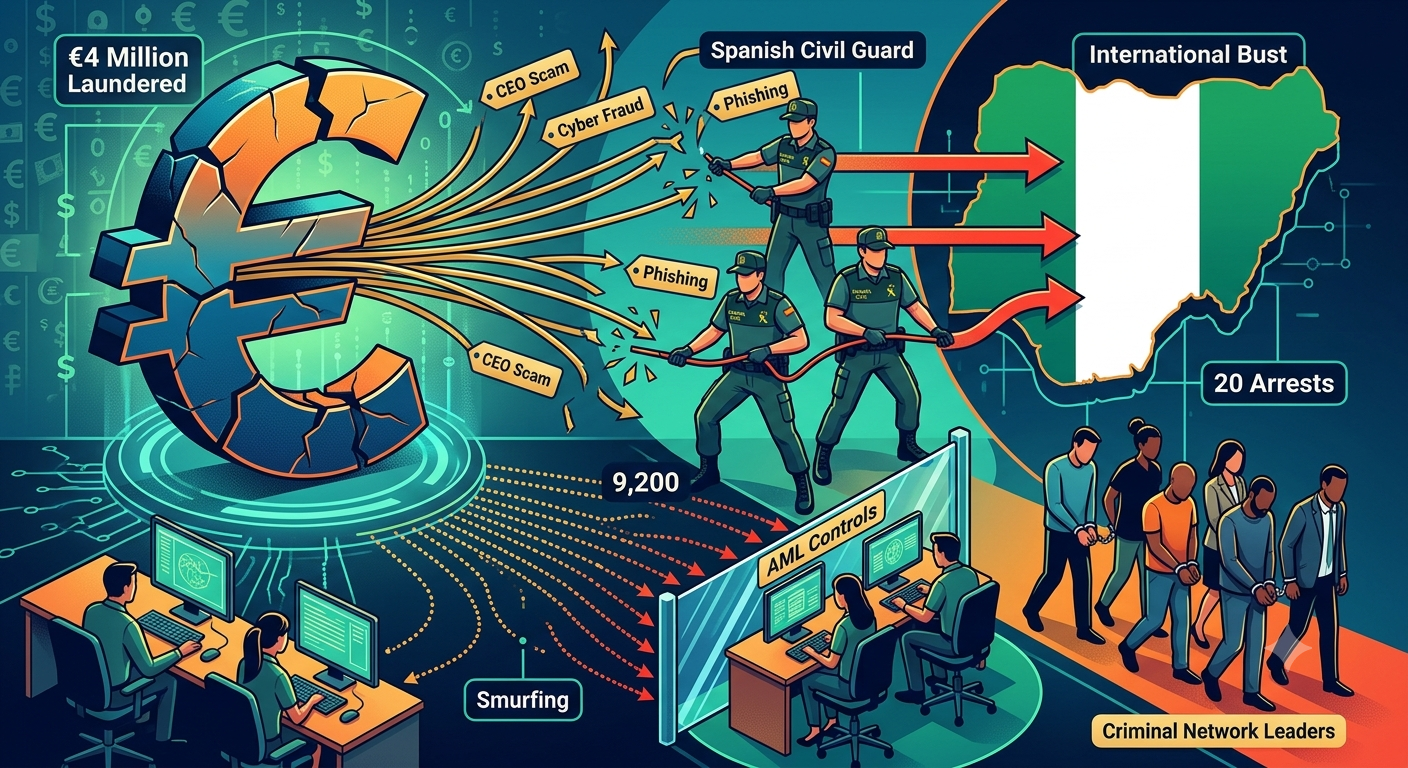
A network that laundered more than four million euros from scams by sending the money to Nigeria falls
Spanish Police Bust €4 Million International Money Laundering Ring Bound for Nigeria. The Spanish Civil Guard has dismantled a criminal network responsible for laundering over €4 million generated through cyber fraud, CEO scams, and identity theft across Europe. The organization utilized "smurfing"—splitting large illicit funds into more than 9,200 small-wire transfers using falsified passports and stolen identities—to bypass anti-money laundering controls and funnel cash into Nigeria. The two-phase operation led to 20 arrests, investigations into 11 others, and raids targeting key leaders in Bilbao as well as several complicit money transfer agencies.
U.S. Regulators Hit UBS With $173 Million in Coordinated AML Enforcement Action
Eight years after promising regulators it would fix persistent weaknesses in its anti-money laundering controls, UBS is paying for what those regulators say it failed to finish.
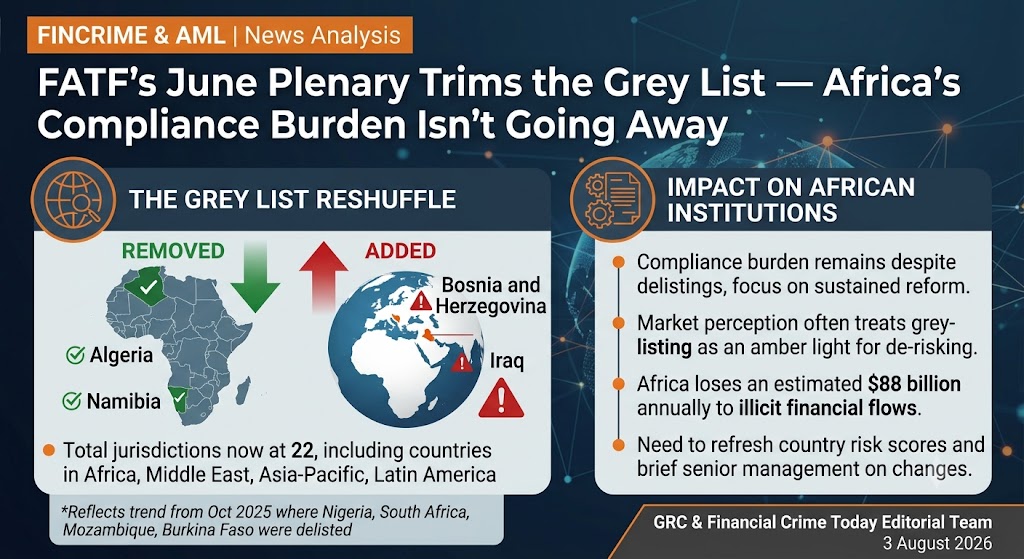
FATF's June Plenary Trims the Grey List — Africa's Compliance Burden Isn't Going Away
The Financial Action Task Force closed its June 2026 plenary by removing Algeria and Namibia from its list of jurisdictions under increased monitoring, while adding Bosnia and Herzegovina and Iraq. For African compliance functions, the headline delisting matters less than what it confirms about the direction of travel.

RegTech Won't Save You From a Bad Governance Model. It Will Just Automate It Faster.
Every compliance leader I meet is being asked, in some form, what their AI strategy is. Almost none of them are being asked the more important question first: what is your governance model for the AI you already have?

The EU AI Act's August Deadline Arrives — Just Not the One Everyone Expected
High-risk AI obligations for financial services have been pushed back sixteen months. Transparency rules for chatbots and synthetic media have not moved at all — and enforcement power against general-purpose AI providers switches on this week.

Third-Party Risk Is a Board Issue Now, Not a Procurement Checklist
Outsourcing does not outsource accountability. Regulators have said this for years. Boards are only now starting to act as though they believe it.
No recommended articles found.