
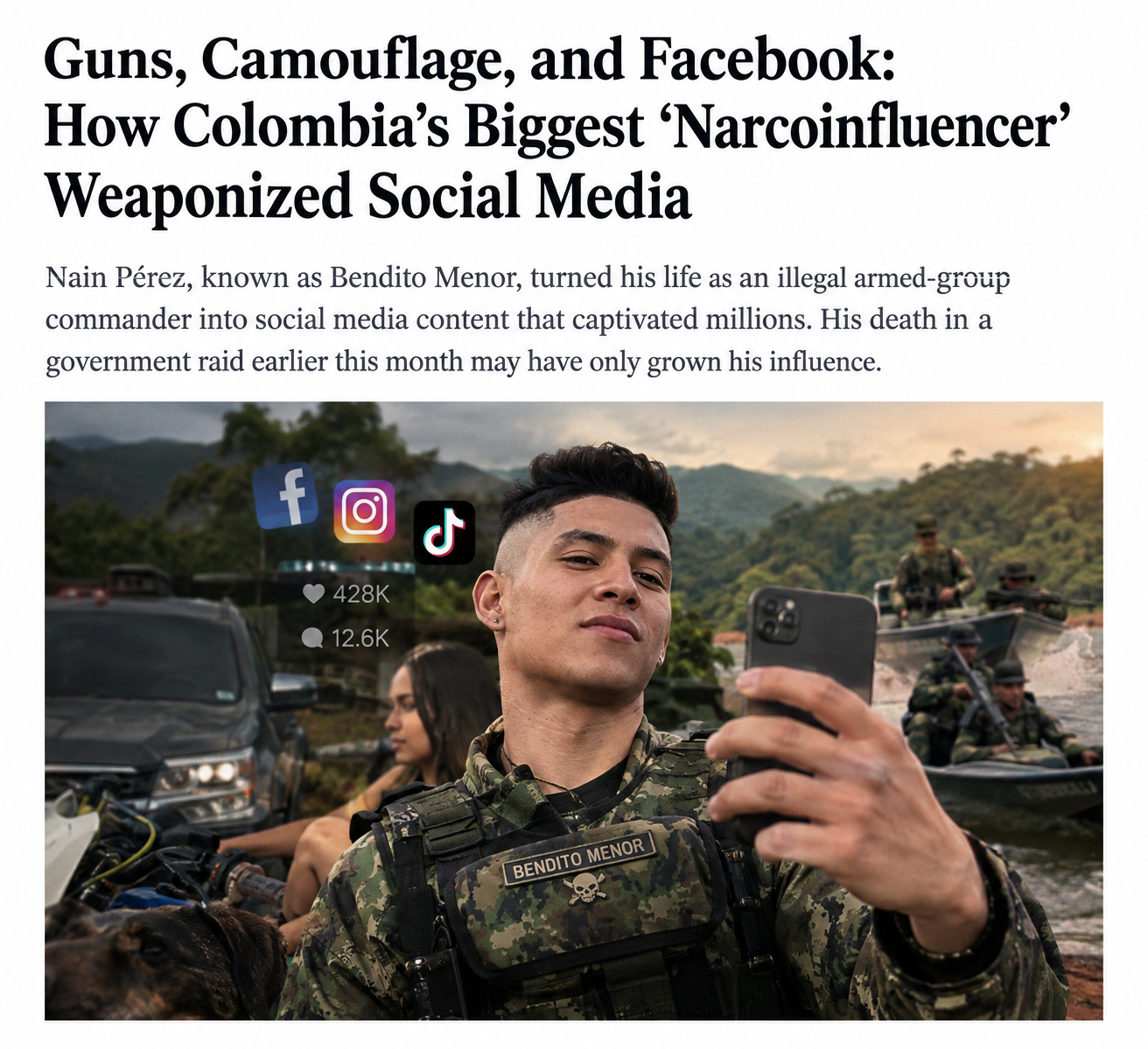
Guns, Camouflage and Facebook: How Colombia’s ‘Narcoinfluencer’ Turned Crime Into Content
Insight . Intelligence . Accountability
A new wave of professionals is transforming Governance, Risk, and Compliance from a rigid framework into a dynamic force for trust, innovation, and resilience. Governance, Risk, and Compliance (GRC) has long been associated with boardrooms and bureaucracy—a domain reserved for executives and auditors. But that image is changing fast.
Nain Pérez had the kind of look that could have made him a successful lifestyle influencer.
At 27, the Colombian had a large following on Facebook, Instagram and TikTok. He posted photos of fast motorcycles, expensive-looking cars and his girlfriend, Rosa Angélica Tarazona, better known online as “Bebecita.” His videos were often set to music, filled with jokes, memes and the sort of images normally associated with an aspirational young lifestyle.
There was just one major difference.
Pérez, who used the alias Bendito Menor, or “Little Blessing,” was also a rising commander in the Self-Defense Forces of the Sierra Nevada, known by its Spanish abbreviation ACSN, an illegal armed group linked to drug trafficking, extortion and other crimes.
He was not the most powerful figure in the organization. But online, he was arguably its most recognizable face.
Pages dedicated to Bendito Menor shared videos of him moving through the jungle, driving an SUV through rivers while wearing military-style clothing and patrolling by boat with armed men. Other posts showed a different side of his image: romantic moments with Bebecita, selfies with dogs and personal reflections about life, fate and success.
That combination helped turn him into a viral figure in a part of Colombia where organized crime has long been a fact of everyday life.
According to Lerber Dimas Vásquez, a research professor who studies violence in the Sierra Nevada, Bendito Menor's appeal came partly from the contrast in his content.
“His videos ranged from gruesome clips to others showing him distributing food or sailing in a speedboat,” Dimas told OCCRP. He said the online persona presented a version of success that could be especially attractive to young people living in poor and marginalized communities.
Teenage boys were not only watching. Locals said some became real-life followers, drawn to illegal motorcycle races Bendito Menor organized in Riohacha and to the phones, motorcycles and weapons he was said to hand out.
His social media presence had effectively become part of his power.
A criminal career, turned into a public persona
Bendito Menor grew up in Riohacha, an economically struggling city on Colombia’s Guajira Peninsula. The region sits between the Caribbean Sea and the isolated Sierra Nevada de Santa Marta mountains, closer to Venezuela than to Bogotá. For years, government authority has struggled to maintain a strong presence there, while criminal groups have established control over important smuggling and trafficking routes.
Internal reports from Colombia's prosecutor's office, obtained by OCCRP, identified Pérez as the head of a small Riohacha gang called the Combo de los Majayura as early as 2021. The gang was accused of murder, extortion and local drug dealing and was described as being affiliated with the ACSN.
The ACSN emerged under that name around 2018, but its roots reach back to earlier paramilitary organizations that operated in the region. By 2026, the group was estimated to have about 600 members and controlled territory around the Sierra Nevada de Santa Marta.
A July report by the Ideas for Peace Foundation, a Colombian think tank focused on armed conflict, said the organization's main income came from taking “commissions” on fuel and cocaine smuggled through the port of Santa Marta and nearby river mouths, where speedboats could leave the coast.
It is not clear exactly when Pérez formally joined the ACSN. What is clear is that he advanced quickly. By 2026, the Ideas for Peace Foundation described him as a key commander responsible for drug-trafficking routes. He had also been linked to multiple mass killings in La Guajira and attacks against security forces, according to the same source.
As his influence grew in the region, so did his visibility online.
Bendito Menor did not appear to operate through one official social media account. Instead, material connected to him circulated through a network of pages and fan accounts using names such as “bendi_tomenor” and “Fansofbenditomenor.”
That created something larger than a single profile. It became an online community built around his image.
Colombian researcher Jaime Andres Wilches Tinjaca described it as a “digital ecosystem” in which followers, admirers, content creators and even people with no direct connection to the criminal group helped spread the same narrative.
OCCRP identified at least 20 Bendito Menor-related accounts across Facebook, Instagram and TikTok with more than 700,000 followers.
The audience was not simply consuming entertainment. Some users were reportedly asking how they could join him or whether there were jobs available.
Wilches said this was a new level of sophistication for narcoculture, the long-running cultural phenomenon in which drug traffickers and criminal lifestyles are portrayed as glamorous, powerful or aspirational.
From narcocorridos to TikTok
Narcoculture itself is not new.
For decades, songs, television dramas and stories across Colombia and other parts of Latin America have portrayed drug traffickers and outlaws as larger-than-life characters. The popularity of stories about figures such as Pablo Escobar helped carry those images well beyond the region.
What has changed is the speed and scale at which those stories can spread.
Instead of waiting for a television producer, musician or journalist to create the narrative, criminals can now participate in creating and distributing their own image. Fans can repost it instantly. Algorithms can push it to people who have never searched for it.
Bendito Menor became a particularly clear example.
At least three original songs celebrating his exploits were available on Spotify, while TikTok and Instagram videos used music and edited footage to build a mythology around him.
One popular song described his rise from poverty to power, turning his story into something resembling a modern outlaw legend. Its lyrics portrayed the mountains as his refuge and government forces as an enemy determined to bring him down.
The real story, however, was much less romantic.
Pérez's rise was tied to an armed organization accused of drug trafficking, extortion and serious violence. The polished social media image did not show the full cost of the criminal economy behind it.
That disconnect may have been part of what made the persona so effective.
A fight with the government
By the middle of 2026, Bendito Menor's online presence had also become entangled with Colombian politics.
The country's newly elected president, Abelardo de la Espriella, had campaigned on a tougher approach to security and publicly identified Bendito Menor as a “high-value target” before taking office.
The response from accounts associated with Bendito Menor was openly confrontational.
One video referred to the incoming president as the “Temu Tiger,” mocking the nickname De la Espriella used for himself. Another video showed military helicopters reportedly searching for Bendito Menor alongside a message insisting that his supporters would remain “steadfast” and unafraid.
A widely shared photograph showed Bendito Menor and Bebecita on a motorcycle, apparently wearing white shirts marked “ANTI-ABELARDO.”
Their online rivalry increasingly looked like a political spectacle.
Then, in the early hours of September 4, Bendito Menor and Bebecita were killed in a late-night government operation, according to the original reporting. Their deaths came as the authorities also targeted other ACSN leaders, triggering serious street violence in Santa Marta and a military deployment.
The killings quickly became another chapter in the Bendito Menor story that unfolded online.
Even the ACSN had concerns
Bendito Menor's willingness to show so much of his life online apparently worried people inside the organization itself.
In a September 12 interview with Colombian newsweekly Semana, Fredy Castillo Carillo, a senior ACSN leader known as Pinochio, said Bendito Menor had been difficult for the group to control.
According to Castillo Carillo, Bendito Menor ignored meetings with senior commanders and repeatedly exposed himself and the organization by posting images of weapons, vehicles and threats.
More seriously, he sometimes revealed his own location.
“He live-published on his social networks that he was in Riohacha,” Castillo Carillo said, arguing that this kind of behavior increased the danger around him.
His death demonstrated the risk.
The same social media presence that made him famous also created a detailed public record of where he went, what he owned, who he spent time with and how he presented himself.
The Robin Hood image
For many people in the communities where Bendito Menor operated, his reputation was complicated.
His funeral procession, held two days after his death, reportedly brought hundreds of motorcycles onto the streets of Riohacha. Videos showed black-clad riders traveling through the city while narcocorridos played and gunshots were fired into the air.
The scale of the funeral shocked observers and became another demonstration of his influence.
In the La Ñapita neighborhood, where his mother lived, mourners continued to gather days later. Young men on motorcycles watched over the area while people came to pay their respects.
Some local business owners spoke positively about him, despite acknowledging that he collected money from them for protection.
One shopkeeper said Bendito Menor had helped drive out a local gang involved in petty drug dealing and extortion.
“He prevented extortion and rid the neighborhood of thieves,” the shopkeeper said.
But that was only part of the picture.
Locals also described him as someone who distributed food, gave gifts and publicly presented himself as a helper of poor people. Images of him giving to charity helped reinforce a “Robin Hood” image.
Dimas, the research professor, said that this mixture of violence and generosity was central to Bendito Menor's appeal.
He could appear in one video committing or displaying violence and in another giving food to someone on the street.
That contradiction allowed different audiences to see different versions of the same person.
For some, he was a dangerous criminal. For others, particularly in places where the state was weak and armed groups played a direct role in community life, he could also appear to be a provider or protector.
The comparison to Robin Hood, however, has obvious limits. Unlike the fictional outlaw, Bendito Menor was accused of extorting people and building personal and organizational wealth through an armed criminal network.
The problem for social media platforms
The Bendito Menor case also highlights the challenge facing Facebook, Instagram, TikTok and other platforms as criminal groups adapt to the digital age.
Meta, the parent company of Facebook and Instagram, said in a Strategic Threat Report that it had removed more than 1,000 accounts, groups and pages in Colombia associated with an unspecified “terrorist group.” The company said those accounts were used to spread ideological material and recruit new members, particularly among younger people.
Meta did not identify the group by name in the report, although the details suggested it was referring to the ELN, a major guerrilla organization.
It was unclear whether Meta had also identified the broader network of accounts promoting Bendito Menor.
After OCCRP contacted Meta about the pages, the company removed a number of Bendito Menor-related accounts from Facebook and Instagram. Some remained visible afterward. TikTok did not respond to OCCRP's requests for comment.
A Meta spokesperson said the company has strict policies covering dangerous organizations and individuals and takes action when it identifies violations.
Critics argue that the problem is bigger than simply removing individual accounts.
Catalina Niño, a project coordinator with the Colombian branch of the Friedrich Ebert Stiftung, said platforms have a major responsibility to stop what amounts to public relations for organized crime.
The concern is not only glorification. These accounts can also help criminal groups recruit, build relationships with communities and create a sense of legitimacy.
That becomes especially important in areas where government institutions already have a limited presence.
A digital afterlife
Bendito Menor may be dead, but the persona he built online has not disappeared.
Some accounts have continued posting messages in his voice, giving the impression that he is still speaking to followers. Others have shared what appear to be AI-generated images of him distributing money and gifts to poor people.
The reaction from supporters has been emotional.
“RIP, fly high my king, it is forbidden to forget you,” one person wrote.
Another said that, regardless of what others thought of him, Bendito Menor had been better than many.
That may be the most difficult part of the story to confront.
His power did not come only from guns or territory. It also came from a carefully built public image — one that mixed violence with romance, intimidation with generosity, and criminality with the language of success.
Social media did not create narcoculture. But it gave people involved in it a direct way to produce, distribute and endlessly repeat their own stories.
And in Bendito Menor's case, the story continued even after his death.
Your email address will not be published. Required fields are marked with *

CPMI and IOSCO Release New Guidance on Managing Business Risks in Financial Market Infrastructures
The Committee on Payments and Market Infrastructures (CPMI) and IOSCO have released final guidance to help financial market infrastructures strengthen their approach to managing business risks and preparing for potential financial losses. The guidance clarifies existing requirements under Principle 15 of the Principles for Financial Market Infrastructures, following an assessment that identified weaknesses in how some institutions were applying the standards.

# Telemedicine CEO Sentenced to 19 Years Over $1 Billion Medicare Fraud Scheme
A Kansas healthcare technology executive has been sentenced to 19 years in prison for his role in a fraud scheme that generated more than $1 billion in claims against Medicare and other federal healthcare programmes. The case exposed how fraudulent medical orders, illegal kickbacks and deceptive telemedicine practices were used to exploit public healthcare funds.
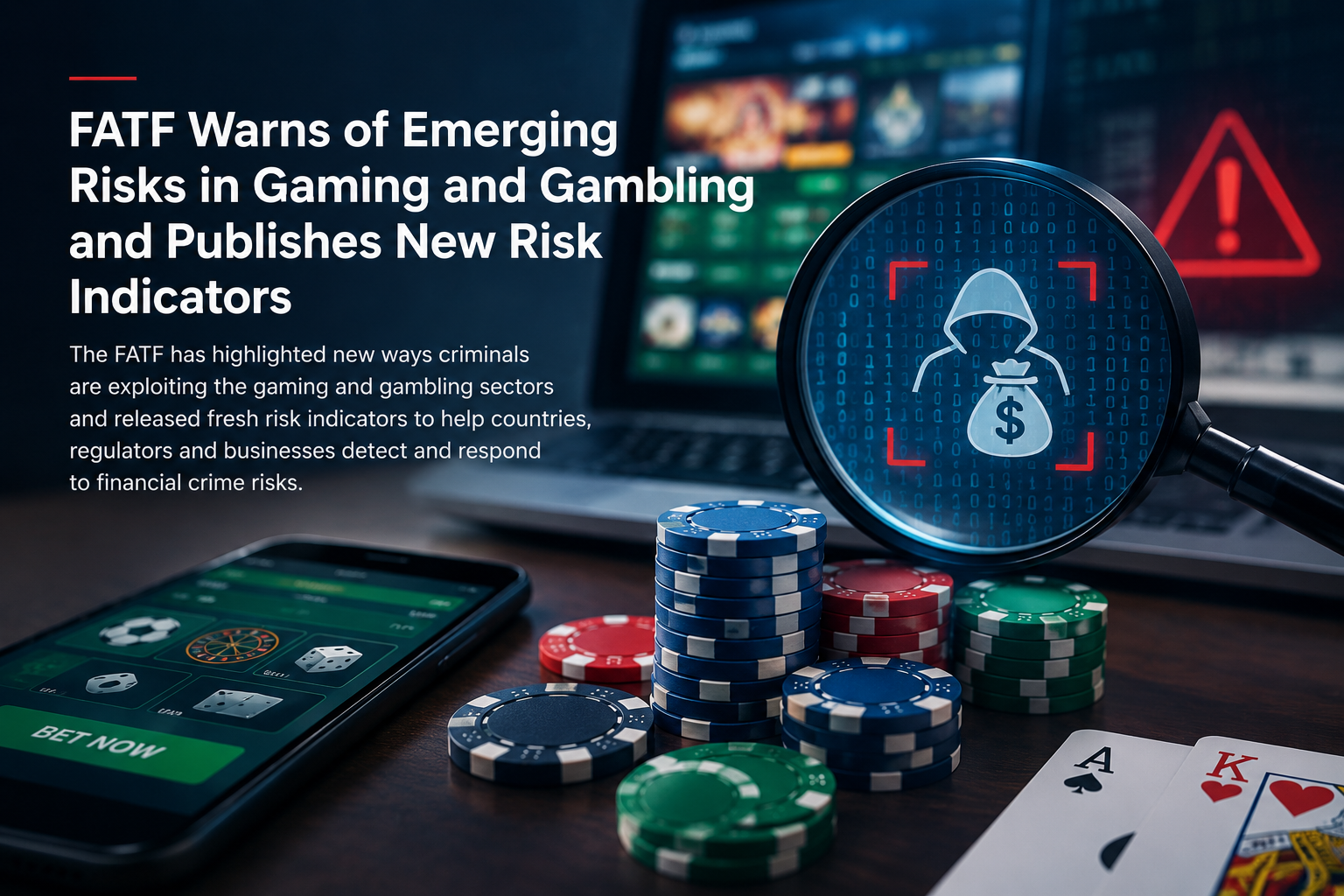
FATF Warns Gaming and Gambling Sectors Face Growing Financial Crime Risks
The Financial Action Task Force (FATF) has identified new ways criminals are exploiting gaming and gambling platforms to move money, evade controls and support wider criminal activity. With online and cross-border gambling expanding rapidly, the FATF has issued new risk indicators to help regulators, financial institutions and industry operators detect suspicious activity and respond to money laundering, terrorist financing and other financial crime risks.
Guns, Camouflage and Facebook: How Colombia’s ‘Narcoinfluencer’ Turned Crime Into Content
Nain Pérez, known online as Bendito Menor, built a huge following by mixing images of money, romance and armed life with a criminal persona. His rise shows how social media can turn organized crime into something dangerously close to celebrity culture.

ENISA Warns Digital Dependencies Are Expanding Europe’s Cyber Attack Surface
Europe’s growing reliance on interconnected digital technologies is creating new cybersecurity challenges, with ENISA warning that increasing digital dependencies could widen the region’s exposure to cyber threats, vulnerabilities and potential disruptions across critical sectors.
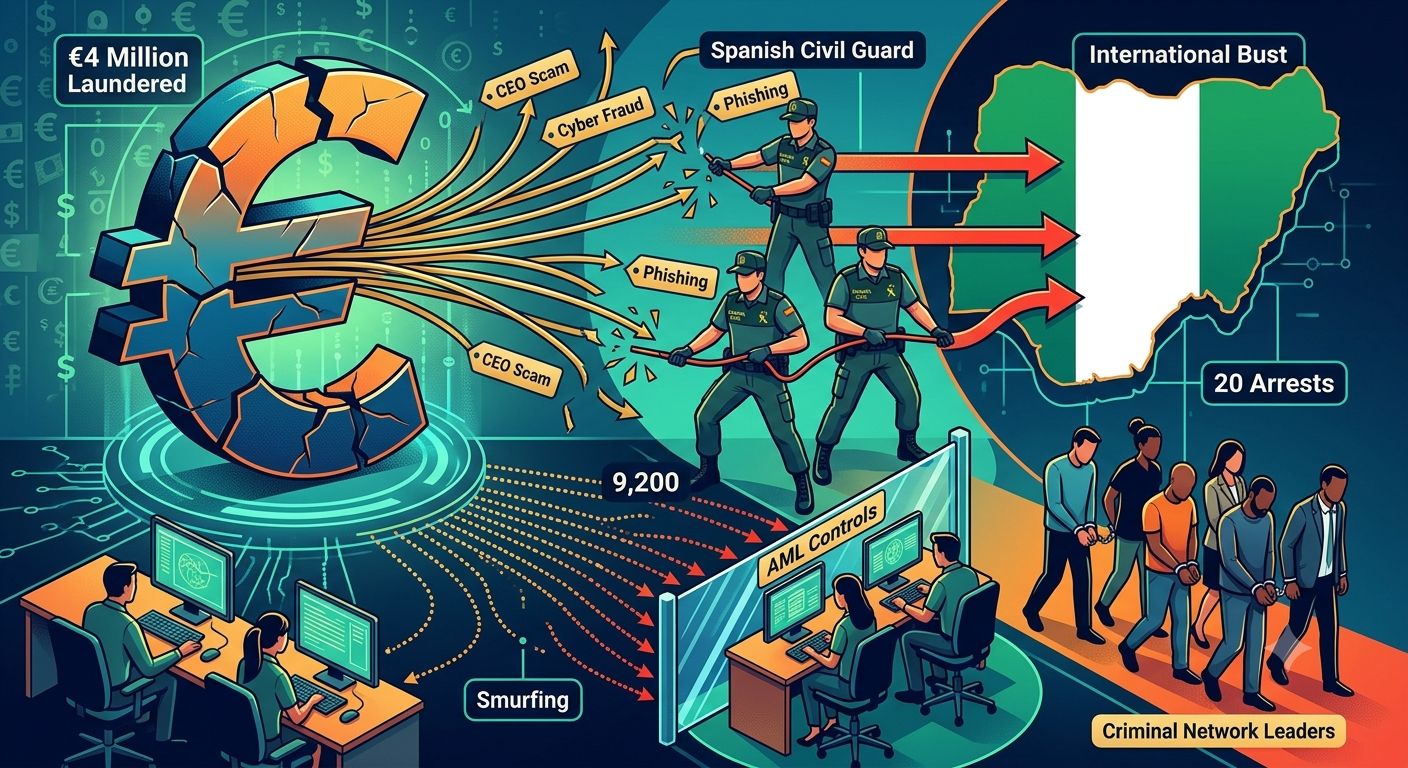
A network that laundered more than four million euros from scams by sending the money to Nigeria falls
Spanish Police Bust €4 Million International Money Laundering Ring Bound for Nigeria. The Spanish Civil Guard has dismantled a criminal network responsible for laundering over €4 million generated through cyber fraud, CEO scams, and identity theft across Europe. The organization utilized "smurfing"—splitting large illicit funds into more than 9,200 small-wire transfers using falsified passports and stolen identities—to bypass anti-money laundering controls and funnel cash into Nigeria. The two-phase operation led to 20 arrests, investigations into 11 others, and raids targeting key leaders in Bilbao as well as several complicit money transfer agencies.
No recommended articles found.